
Sectional Sliding Gates on the Gold Coast
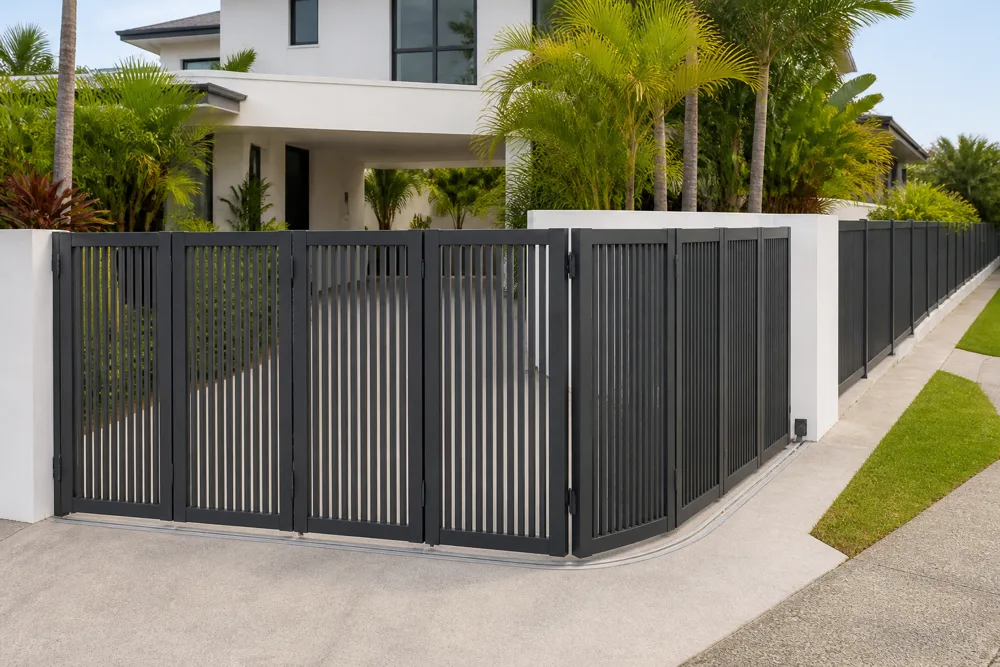
A sectional gate is built from narrow hinged sections that run on a track. When it opens, the sections follow the track around a corner and park along the side fence, so it works where there is no straight fence line beside the driveway.
When a sectional gate makes sense
Sliding gates need room to park. Telescopic gates halve that room, but some driveways have almost none: the opening runs right up to a corner, a wall or the side boundary. A sectional gate is usually the answer when:
- the driveway opening finishes at the corner of the front fence
- there is a side fence or garden bed running back from the corner where the gate can park
- a swing gate will not work because of a slope or a short driveway
The gate turns the corner as it opens, so it parks along the side fence instead of across the front of the house.
How it works
The gate is made of narrow sections joined by hinges. Each section rides on its own rollers in a floor track that bends around the corner. When the gate closes, the sections line up straight across the driveway. When it opens, they follow the curve and line up along the side fence.
The track and its curve are set into concrete, so the shape of your corner, the ground level and the drainage all matter. We check those on site before the gate is designed.
Built to measure in aluminium
Every sectional gate is made for its corner, so the section width and the curve are set to your site. Aluminium keeps each section light and rust free, which matters on coastal blocks. Vertical slats suit sectional gates best because each section reads as part of a continuous fence, but horizontal slat and louvre styles can also be made.
Colours come from the standard powder coat range, so the gate can match your aluminium fencing and side gates.
Manual or automatic
Sectional gates can be pushed open by hand, and they can also be automated with a sliding gate motor. We plan the motor position at the design stage so the drive and safety beams suit the curved track. See gate automation for motors and remotes.
What to have ready for a quote
Measure the width of the opening, measure the side fence line running back from the corner, and take photos from the street and from inside the corner. That tells us whether a sectional gate will fit and how tight the curve can be.
Why choose us for sectional gates
- Works where there is no straight run-off room
- Hinged sections follow a curved track around the corner
- Parks along the side fence, not across the house
- Made to measure in powder coated aluminium
- Can be automated with a sliding gate motor
Sectional Gates — common questions
What is the difference between a sectional gate and a telescopic gate?
A telescopic gate has two or three full leaves that stack behind each other in a straight line. A sectional gate has many narrow hinged sections that follow a curved track around a corner. Telescopic needs some straight fence line; sectional needs a side fence to park along.
How tight can the corner be?
It depends on the section width and the space inside the corner. We measure the site and design the curve to suit before the gate is made.
Can a sectional gate be automated?
Yes. A sliding gate motor can drive a sectional gate. We plan the motor and safety beam positions at the design stage so they suit the curved track.
Ready to plan your new gate?
Tell us about your project to request a free quote.